To
read between lines:
"In
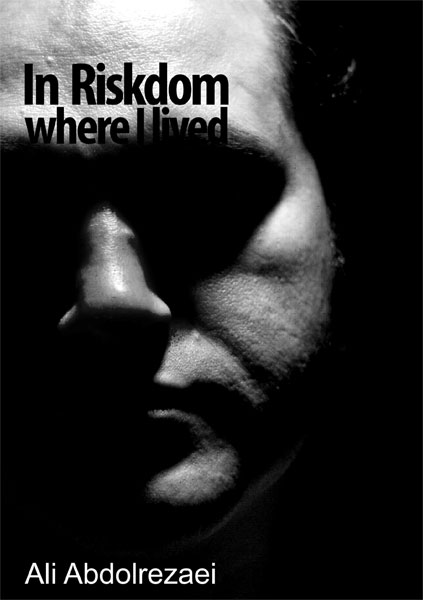
Riskdom where I Lived" is the title to a collection (1) of 28
poems by Ali Abdolrezaei with a wide typo-topical range.
Postmodern Persian literature is difficult to define its exact
characteristics, scope, and importance. However, one could specify
that the unifying features of Abdolrezaei's poetry rest upon the
denial of "Meta-Narratives" (Jean-Francois Lyotard) and "archetypal
patterns" (Carl Gustav Jung). For example, instead of the modernist
quest for meaning in a chaotic world, his poetry eschews, often
playfully, the possibility of clear cut meanings.
He breaks away from objective reality in that a narrative is told
from an objective or omniscient point of view. In favour of
subjectivism, in poetry he turns from external reality to examine
inner states of consciousness. In addition, he explores
fragmentation in narrative- and character-construction. The poem:
"At the Priory" is often cited as an example of this style. This
poem is fragmentary and employs pastiche to demonstrate the working
of extreme subjectivity as an existential crisis. What we call
reality is actually the construction of our minds. This is to say,
our lives are not the subject of random fate, but reality is of our
own making. It is shaped by manipulation of material events and
emotions around us from a logocentric point of view.
Perhaps demonstrated most famously and effectively in poem "Mother me out!" is the belief that there's an assumed ordering system behind the chaos of the world. For the poet though, no ultimate ordering system exists, so a search for order is fruitless and absurd. The poem has many possible interpretations.
The sprawling canvas and fragmented narrative of the poem "Bandar Abbas" has generated controversy on the "purpose" of the narrative and the standards by which it should be judged. Abdolrezaei believes that the style of a poem must be appropriate to what it depicts and represents. The post-revolutionary Iranian socio-cultural landscape is a text that with the help of the poet can be read and understood. This poem provides us with a narrative vision which is in sharp contrast with the utopian dreams preceding the 1979 Iranian revolution. If post-Revolutionary Iran was a new Eden, or alternatively, a New Canaan, then it positively demanded poets who could articulate those metamorphoses/ manifestations envisaging such destiny:
In poem "Junction", it
seems to define the attitude of a generation exuding a much needed
confidence in an age that, following the reign of the totalitarian
regime in post Revolutionary Iran, could easily descend into
disillusion and decadence. There exists, desperately, a quest for
action demanding recognition that the status quo has to change.
Abdolrezaei's work is, prophetically, heralding something new about
to emerge into view. His imagery is consistent with contemporary
life representing the spontaneous expression of the poet's thoughts
and feelings. He sees poetry as a vital part in the process of
creating transformation.
The poem is the
identity of the poet actualised in the process of writing it. By the
same token, one can argue that poetry enacts identity for the reader
as s/he gets engaged in the re-creative process of reading. Thus,
poet and audience create, interactionally, a brief momentary sense
of communion through a fragile web of words. The poem "Park" indicates that there exists no teleological sense of Progression and development as life circles back and forth. In the poem
called "Go as the go that I went", by taking up the “I” role, the
poet demonstrates that actually there is no difference between his
role and the “Other”. Never throughout his career, has Abdolrezaei
presented a stable sense of the "I" in his poems.
As the poem draws to a conclusion in which very little is actually
concluded, the narrator seems to be speaking only for the elusive
character of his own identity. The
self-conscious dialogue between the poet's varied personae sets the
tone of the poem "Dictation". The poem interrupts itself twice with
a third commanding voice while the poet looks back over his life.
Although the poem is written in the first person, the reader learns
little about the protagonist, who remains a representative figure.
The "I" of the poem can speak for all men because no particular
identity is ascribed. The mood of the poem brushes with tragic in
the final stanza, in that a new poem "always rubs out other poems".
Thus, the final line: "Poets! Stop writing hands up" is a verdict in
the sense that defeat is inevitable and all people will die. There is a challenging risk the proponents of the convention may pose: are you playing the role of this or that character? The poet has given in advance his verdict: I am this and that and the “Other”. I am enacting them all. To say this is to relinquish any demarcation between wickedness and righteousness. In art as in life, he doesn't mind being confused with slovenliness or a lack of consideration for others. This approach is in sharp contrast, for example, to British great poet W.H. Auden who said in 1965:
In these assembled rather short pieces, a glimpse of his poetic intentions and range of theme/ genre is available to English readers. Obviously for a better understanding, one has to look at his writings from a historical perspective i.e. their main chronological order. At first his work
is too obscure and dense. But its richness of imagery, its
uniqueness of language and sudden surprising shifts of diction are
remarkably convincing as the dust of obscurity settles. In his
poetry, there is a tendency to use personal/ social references which
an unfamiliar reader cannot place. This spectacular ability to
discuss vast areas of human experience through his own brand of
psycho –politics, if not daunting his rivals, nevertheless has been,
quietly, inspirational to his opponents. Some critics have attacked
certain lengthy poems as being maximalist, disorganized, sterile and
filled with language play for its own sake. Abdolrezaei can't, except with considerable reluctance or qualification, confine himself and his creativity within the strait-jacket of Persian orthodox perspective i.e. create poetry less individualistic and idiosyncratic. In spite of the risk of appearing eccentric or anarchic, he seems to speak to us from out of the depths of his solitude through schemata largely unmediated by social or literary convention. So to invent, to unravel a form via which he can express his own vision of life, may be interpreted as a means to self-definition and as a demonstration to seek identity. Nevertheless, his language and his sense of identity are interwoven and have been changing respectively. Since poetry is,
primarily, a drama of the self, it wouldn't be Tautological to say
that the notion of the self itself has its source in language that
never inheres in the real. That is because writing i.e. the act of
turning experience into language possibilities, deals, in the first
instance, with epistemology and matters of cultural perception and
communication. Finally, I wish to reiterate that this anthology has come about as a result of efforts made by Abol Froushan as the translator of the poems from Persian into English. I should cite that Abol Froushan himself is a poet whose work has been published widely. For Abol words as objects per se, representing sound and forms, are of far more significance than they generally are for Abdolrezaei. Having said that, though, it must be said that just like Abdolrezaei, Abol is concerned with rendered experience rather than statement. He believes in organic form, rhythm and cadence that are necessary product of a particular moment and voice.
It seems Abol's poetry adheres to a great extent to Objectivism
wherein the concern with music, sound and sensuous is at its
strongest. The "objectivist" attempts to make poetry as intransitive
as music or painting can get. In line with this approach, ideas are
presented sensuously and intelligently and no predatory intention is
pre-meditated. In his work, meaning is subordinated to sound, in
that the individual word becomes an object and that the order and
movement of sound in a poem might create a flux of emotions more
significant than the underlying literary meaning.
1- This book was published by Exiled Writers INK. 2- Collected Poems: edited by Edward Mendelson: 1994: Author's forewords
3- Finally, thanks to Dr Helen Pearce for help in editing this text.
|
 |